International Volunteering Opportunities with A Rocha Peru

From June to August, A Rocha Peru had the joy of hosting Valeria, an international volunteer who dedicated over two months of her time and energy to caring for creation in Pacasmayo. Working full-time, she became a key member of the Proyecto Bosque Seco team, bringing creativity, initiative, and a great desire to learn.

“My main responsibility was to support the team in Pacasmayo, which was in charge of the Proyecto Bosque Seco,” Valeria shares. “I helped plan and organize workshops on environmental topics such as microplastics and water conservation in Peru.” Her days were filled with activity: she painted signs for a school garden, organized a field trip to Bosque Cañoncillo, and designed educational games that helped children learn in a fun way.

Along with a group of women from the community, she participated in embroidery workshops and helped design a logo for the handmade bags they create. “The goal was to help them sell their products, even internationally,” she explains. Her creativity also reached the Proyecto Amazonía, where she led a painting workshop using natural materials, such as stones found in the area, to make the communal space more welcoming and full of life.

Beyond the skills she gained, what impacted Valeria the most was the experience of living and working closely with the local community. “The most rewarding part was seeing how consistency and genuine presence build trust and connection, where mutual support and solidarity are a natural part of daily life,” she reflects. “I realized that conservation is not only about protecting ecosystems but also understanding the needs and hopes of the people who live there.”

But Valeria was not the only volunteer who had a transformative experience. Noah, who came from Nashville, United States, was also part of the project, and his story of adventure and connection is equally inspiring.

Noah working with local kids (July, 2025)

Noah, who is the Conservation Coordinator at A Rocha USA, decided to do international volunteering in Peru to contribute to the Proyecto Amazonía and collaborate with the Machiguenga community in Monte Carmelo. During his time there, Noah focused his efforts primarily on maintaining the greenhouse in Monte Carmelo, where he collected seeds, cared for plants, and maintained the space to ensure the greenhouse continued to be a vital resource for the community.

Additionally, one of his main focuses was conducting interviews with members of the Machiguenga community. This resulted in two main products: a visual guide of the cultural knowledge the Machiguenga have regarding ecological indicators, such as signs to know the timing of fish egg-laying or when to plant or hunt, and written versions of the Machiguenga’s ancestral legends, both for adults and children. These versions were intended not only for the community’s use but also as reference material for A Rocha Peru.

One of the most meaningful aspects of his experience was the opportunity to document the Machiguenga’s ancestral legends, a project Noah described as a true honor. “I had the opportunity to listen to the stories, myths, and legends of the community, and being able to work on them has been incredibly valuable,” Noah shared. This work, besides being an enriching experience for him, has a profound and lasting impact on the community. The ability to preserve this knowledge without it being lost across generations is a true gift, both for the Machiguenga community and for A Rocha Peru.

Through volunteers like Valeria and Noah, A Rocha Peru continues to build bridges: between people and nature, between cultures, and between generations. These testimonies reflect how the adventure of international volunteering not only changes lives but also creates meaningful connections that endure beyond borders.

The Machiguenga Botanic Garden as a Bridge Between Tradition and Nature

In the Native Community of Monte Carmelo, a new space of life and learning has taken root. After six months of work, the Machiguenga Botanic Garden has been completed: a place where ancestral wisdom and environmental conservation come together in harmony.

This initiative began in April, when the community of Monte Carmelo formally granted one hectare of land for the creation of a community botanical garden. From that moment, A Rocha Peru, together with local residents and the respected elder Máximo Kategari, began a journey of restoration and collaboration. The work included clearing and conditioning trails, identifying native species, collecting medicinal plants, and installing interpretive signs that tell the stories and uses of each one.

Throughout the process, the garden became more than just a conservation space: it became a meeting point for generations. The participation of the Local School of Monte Carmelo and several community volunteers strengthened the connection between traditional knowledge and modern science. For the youth, it is an open-air classroom; for the elders, it is a living testimony of their cultural heritage.

Now completed, the Machiguenga Botanic Garden will continue to grow as a space for education, research, and community reflection. Its goal is to identify and document 100% of the species present, ensuring that each one becomes a tool for learning and conservation.

Beyond its ecological importance, the garden symbolizes unity and continuity. It preserves the medicinal plants that have healed generations and invites new ones to care for the forest with the same reverence. Through this effort, Monte Carmelo shows that protecting nature is also a way of protecting memory, and that in every leaf and root, life and wisdom flourish together.

Medicinal Plants Workshop in Monte Carmelo

The classroom transformed into a forest full of stories, aromas, and living memories. At the Igoriteshiari Primary School, in the Native Community of Monte Carmelo, a deeply enriching experience took place: educational workshops on medicinal plants, guided by a local elder—an ancestral keeper of the forest’s healing secrets.

Second Medicinal Plants Workshop at the Igoriteshiari Primary School (June, 2025)

Over the course of this trimester, two workshops have been held, benefiting more than 40 kids, from this school. In each session, students learned which plants help soothe stomach pain, which promote sleep, and which ones need to be protected because they’re becoming scarce. Every plant shared carried a story, a family memory, a lesson on how to care not only for the body but also for the environment.

More than just workshops, these were acts of cultural transmission. For many children, it was the first time they heard someone speak with such respect and depth about the medicine that comes from the forest—medicine that has healed generations before them. The elder didn’t just explain the properties of the plants; he taught them to see the forest with new eyes: not as a mere resource, but as an ally to be respected and protected.

Promoted by A Rocha Peru, these spaces aim to revalue traditional medicine as a vital part of local knowledge, to promote forest care, and to strengthen cultural pride in the living heritage of Amazonian communities.

Connecting youth to nature

By Grazia Rabasa

In our ongoing commitment to environmental conservation, A Rocha Peru is excited to share some of the progress of our latest initiative, the Amazon Natural and Cultural Heritage Conservation project.  Central to our project is the importance of preserving the Amazon rainforest and the rich cultural heritage of the Machigengan people.

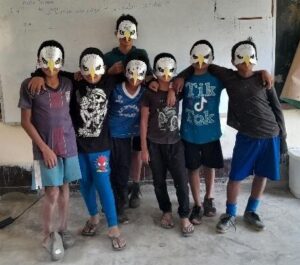
Eco-club Workshop creating bird masks, August 2023

One of our project objectives is to enhance environmental awareness among the younger generation about the conservation of the forest, flora, and fauna. In 2023, the pilot created an eco-club called Katsari Forest in the primary school in Monte Carmelo.  The eco-club has provided 66 enthusiastic students a platform to actively engage in environmental conservation efforts.  Through a series of workshops, including discovering the world of birds, getting to know the tropical forests and discussions on deforestation, we are empowering these young minds to become advocates for their environment.

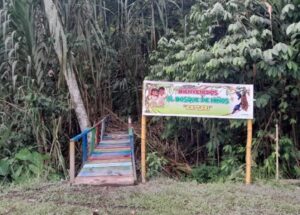
Bridge access to the Katsari children’s forest, August 2023

Moreover, our project extends beyond education to practical solutions like building a bridge to access the Bosques de los Niños (Children’s Forest).  This bridge not only facilitates the children’s exploration of the forest but also symbolizes our dedication to fostering a deep connection between communities and their natural surroundings.  By empowering communities, preserving cultural heritage, and safeguarding biodiversity, we are laying the groundwork for a sustainable future for both people and the planet.


Bird Monitoring in the Amazon

Nestled in the heart of the Peruvian jungle, Monte Carmelo stands out as a testament to the rich biodiversity of the region. Monte Carmelo, located in Cuzco, boasts a myriad of habitats – from high-altitude grasslands and cloud forests to low-lying valleys. Such ecological diversity provides a home for an astonishing variety of bird species, making the area a magnet for ornithologists and bird enthusiasts alike.

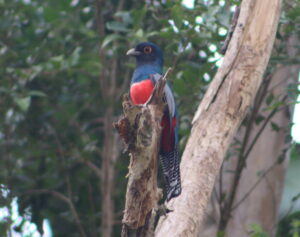
Blue-crowned Trogon (Trogon curucui)

The Amazon Natural & Cultural Heritage Conservation Project is working with the local community of Monte Carmelo to aid in the conservation of avian diversity and promote bird watching tourism. In an effort to understand the conservation status of the resident bird population, research was undertaken.  A considerable amount of bird species was documented, through field surveys, acoustic monitoring and citizen science guided by our field expert Hugo Marcos Loyola.

Field surveys reveal that the Military Macaw, the White-winged Trumpeter and the Razor-billed inhabit the area.  Military Macaw has been listed as Vulnerable on the IUCN’s Red List of Threatened Species.  In addition, the White-winged Trumpeter and the Razor-billed are classified as Near Threatened.  The new birdwatching group observed the Russet-backed Oropendola, Blue-crowned Trogon, and the Common Squirrel-cuckoo, amongst others.  The biodiversity of the jungle is a treasure that we must value and protect. With initiatives like this one, we take another step towards the conservation and understanding of our natural environment.

A Volunteering Adventure with A Rocha Peru

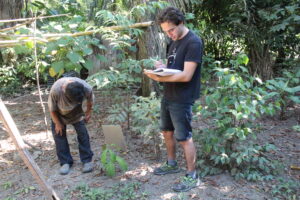
Chris identifying medicinal plants with Sabio (H. Marcos, June 2023)

In January, A Rocha Peru was excited to receive a new volunteer, Chris Rampersad, a Biologist from the United Kingdom. Chris stayed for three months working on several project activities for the La Libertad Dry Forest Project. He talked with locals about the effects of climate change on the dry forest and also helped the team monitor research plots installed in ACP-Cañoncillo to assess the biomass and necromass of the dry forest. One of his findings was an increase in the height of the trees, with an average growth rate of 2.56m since 2018.

In addition, Chris started his research in Tronco Prieto and ACP-Cañoncillo forests collecting data such as species richness, the abundance of each species, and the amount of felled and dry trees. Chris completed his investigation of pre-existing species in the area, conducting two interviews at the Raimondi Museum and the Trujillo Herbarium.

Afterward, Chris journeyed to our Amazon Natural and Cultural Heritage Pilot Project in Monte Carmelo in the Urubamba River basin. Chris has been helping the team take pictures and support the research into the community’s medicinal knowledge of plants, endangered birds, amongst other things.


A New Pilot Project in the Peruvian Amazon

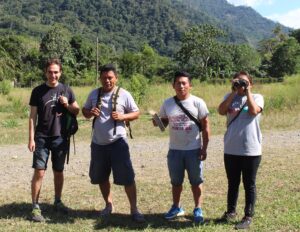
Bird Watching, Monte Carmelo (H.Marcos, July 2023)

The Amazon Natural and Cultural Heritage Pilot Project began in June this year. The pilot project works in a small community called Monte Carmelo, located in the basin of the Urubamba River in the Southeastern Peruvian Amazon. A Rocha Peru partners with the Comunidad Nativa Machiguenga Monte Carmelo (Monte Carmelo Machiguenga Indigenous Community) to help conserve and restore ecosystems and endangered species and preserve the cultural traditions and ancestral knowledge in native communities. The project is currently researching birds and medicinal plant species in this area.

To preserve traditions, workshops and talks will be conducted by elders to spread knowledge to the younger generation on the uses of traditional medicinal plants, the Machiguenga language, and other ancestral customs like hunting with bow and arrow.

For the local school, the project is establishing a recreational forest park to create an opportunity to teach children and others about the environment and the importance of preserving natural ecosystems.  Stay tuned for more developments in the coming months!